
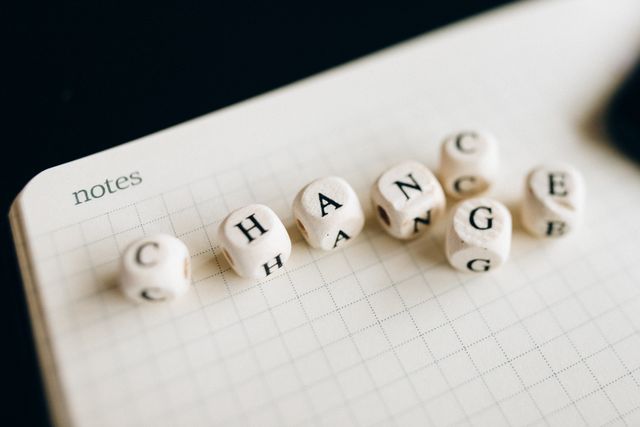
what is change management?
Whole bookcases have been written about it, but at its core we see change management as a skill: the ability to combine vision, strategy, perseverance, empathy, insight into people and goal-oriented work to realise "something". Because people are often the most critical factor in a change, our focus is on its human aspects.
By "change" we mean, in its most elementary form, a shift from situation A to situation B that has an impact on the thinking and/or actions of those involved: a new IT platform, a relocation, an adjusted process, the step from waterfall to agile, from a classic structure to self-management, and so on. Each of these requires a change in behaviour or thinking.
what is the purpose?
Change management supports the efficient realisation of the business goal of a change, with the human side as the focus. It cannot be separated from that "hard" finality: there is a strong interplay between the two. The art is to find the right balance between business necessity and ambition on the one hand, and feasibility on the human-organisational level on the other. A good balance maximises the chance of results, in both the short and the long term.
why change management? what is the value?
The figures do not lie: McKinsey found a return of 143% for projects with a well-founded change approach, compared with 35% without. Besides that direct impact (higher chance of success, lower failure costs), there are often also indirect costs when you fail at good change management: the loss of your best people and their knowledge, energy that evaporates in the corridors, and dropout due to pressure. You can read the full business case in Why change management? The value and impact.
which approach do you choose?
Top-down or bottom-up? Top-down gives speed and clear direction, but risks resistance and blind spots. Bottom-up gives involvement and sustainability, but is slower and harder to coordinate. In practice, a hybrid approach often wins: management sets the broad lines, the shop floor gets room for implementation and fine-tuning. The trade-off is set out in Which change approach to choose: top-down or bottom-up?
which change model do you choose?
Kotter, ADKAR, Lewin, Kübler-Ross — there is an abundance of models. The pitfall is to think in black and white and elevate one model to the solution. Our view: it is an AND, not an OR story. Choosing is not about the best model, but about knowing which model is most useful when. Read why in Which change model to choose?
five tips from practice
Many changes want too much in too little time and are abandoned too soon. Five tips help to avoid that: be realistic about what the organisation can handle, make progress measurable, opt for honest transparency, take account of shifting coalitions, and (perhaps most importantly) persevere. The full elaboration can be found in Five practical tips for change.
is change management only for the change manager?
No. We are convinced that change management is a skill that every leader should have in their backpack — because the leader is closest to the team. The level of expertise may differ, but combining domain knowledge with a solid dose of change skill increases the chance of success of any change. Which competencies exactly make up that change skill and how you build them, you can read in Change management expertise: the competencies behind successful change.
Our conviction
Change management is not a bag of tricks and not a separate process alongside the business, but the skill to make change land — with people at the centre and the balance between IQ (process, structure, figures) and EQ (behaviour, motivation, psychology) as the common thread. Change is a verb: concrete, evidence-based, never one-size-fits-all.


